
Aleister Crowley and the Star
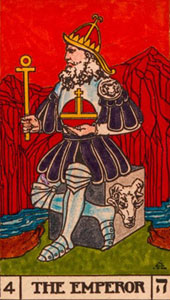
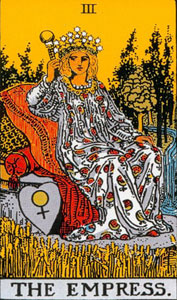
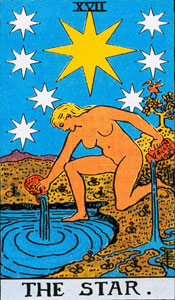
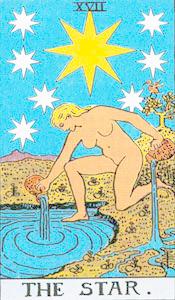
[Tarot Index] Why did Crowley switch the Emperor and the Star? Short answer: he was an idiot. At least about Hebrew and classical astrology. Now that we have your attention, a longer answer with an important conclusion: The story goes that Crowley was in contact with an extra-dimensional entity (Aiwaz), who told him, in the course of things, "All these old letters of my Book are aright; but tzaddi is not the Star." ("Book" = Tarot; "letters" = Hebrew letters corresponding to the Tarot cards). Crowley took this to mean that the Star trump is not in its correct place, and thus does not correspond to the Hebrew letter Tsadde. The truth was that "all these old letters" were actually not aright and there was nothing wrong with either the letter Tzadi (Star) or the letter Hay (Emperor). The real problem, of course, was with the seven double Hebrew letters and the planetary symbols, and the only mistake among the zodiacal signs, the obvious Strength-Justice reversal, had already been remedied by Mathers and the Golden Dawn. The Emperor and the Star corresponding to the Hebrew letters Hay (Aries) and Tsadde (Aquarius) are as natural and correct as Strength and Justice corresponding to Tayt (Leo) and Lammed (Libra). Crowley's me-tooism seems a little transparent and he really created a problem where there was none by ignoring the obvious zodiacal symbolism of the Emperor (initiator of the zodiac, Hay/Life formative of Aries) and Tsadde (water-bearer, formative of the feminine structuralizing Aquarius). The megalomania involved in moving two whole constellations out of their observable order and/or doing psychotic violence to the semantic structure of the Hebrew alphabet is breath-taking, and why anyone would lend any credence to this foolishness is beyond comprehension. Better to have left well-enough alone. Spirits are notorious for speaking in a way that is true but bound to be misunderstood by the psyche of the receiver. Tsadde is not the Star because Tsadde is the woman, feminine structualizing energy in a dual flow. Look. at. the. picture. The Star is a symbol of the Aquarian transfiguration of femininity, where womanhood is liberated and perfected. This was, perhaps, a little too much for Crowley's Victorian mind -- he tried to displace the feminine from her proper place, how anti-feminist can you get -- which resisted an ironic prophecy of the destruction of patriarchal structures to come. Tsadde (Hebrew, 90) is the female structuralizing energy of Tayt (Strength) projected into actuality, where it can ultimately find perfection in its own exaltation as Tsadde in final-letter (Hebrew, 900).
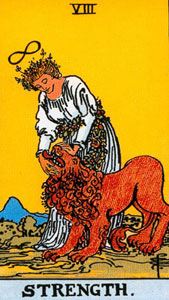
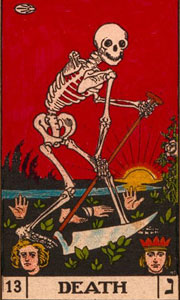
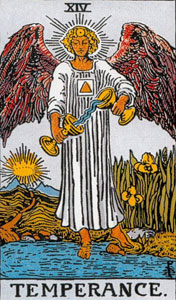
Strength: Woman bending over lion, either opening or closing its mouth. Star: Woman bending over water, pouring two streams into both water and land. The Star transfigured: Tsadde Final: the 27th letter and last final of the Hebrew alphabet. And Crowley wanted to put the Emperor beneath Strength? He doesn't seem able to count to nine in Hebrew. Suares emphasizes that the key to human evolution is in the development and transformation of the feminine in the psyches of both sexes. This transformation has an effect on personal, interpersonal and societal relationships and is based on dissolving the obsolete structures that hinder human equality and development. Saturn (Shabatai) is dead (Mot) in Aquarius (Deli). Women will play primary roles in the social and political structures of the next (Aquarian) millenium, or life (Hhaim) won't be free for its realization in Capricorn (Ghedi) two thousand years from now. Here's an example of the muddle:
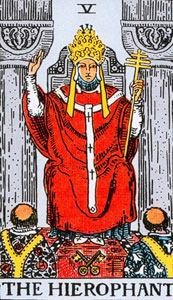
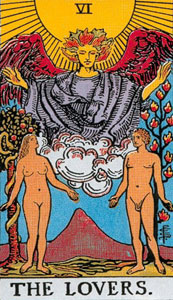
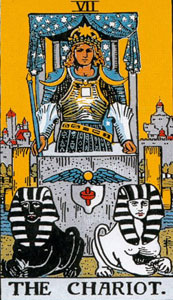
"VIII", however, is neither Strength nor Justice, being really Hhayt, 8, the Chariot. When the natural bond of the letter-numbers of the Hebrew alphabet with both quality and quantity (Aleph=1, Bayt=2, Ghimmel=3 ... Hhayt=8) is broken, things quickly fall apart. The disjunction is entirely an invention of the European mind -- no one thinking in Hebrew would dream of setting Aleph = Zero. When non-Hebrew-literate "initiates" get involved with the Tarot:
"Feel right." Ok. The important point of all this is that the land of magical thinking (Aur Kasdeem) must be left behind. There is actually a completely rational structure behind the astrological (and elemental) expressions we know as the major tarot trumps. These are in turn expressions of the twenty-two letters of the Hebrew alphabet -- and why there are twenty-two tarot. The tarot, when understood in its proper natural sequence is a key to mysteries much greater than Crowley ever imagined. Back to Tarot Index. More on Aleister Crowley - Wikipedia The Great Beast Crowley and Jung: The Guru/Messiah Syndrome Crowley: prophet of a new aeon or era for mankind Aleister Crowley : The Racist And Nationalist And the Star: "These" Tzaddi is not the Star Liber Tzaddi: Practicus Data (GWB: AA) (by 333!) The Path of The Emperor The Arcane Archive - Crowley's Tzaddi Switch and the OSOGD Temple of Thelema - Tzaddi is not the Star Links: Magical Systems
|


 |
 |
 |
 |
 |
 |
 |
 |
 |
 |
 |
 |
 |
 |
 |
 |
 |
 |
 |
 |
 |
 |
 |
 |
 |
 |
 |